
Beyond the Farm: How Solar Energy can Transform Nigeria's Agriculture
12 October 2026
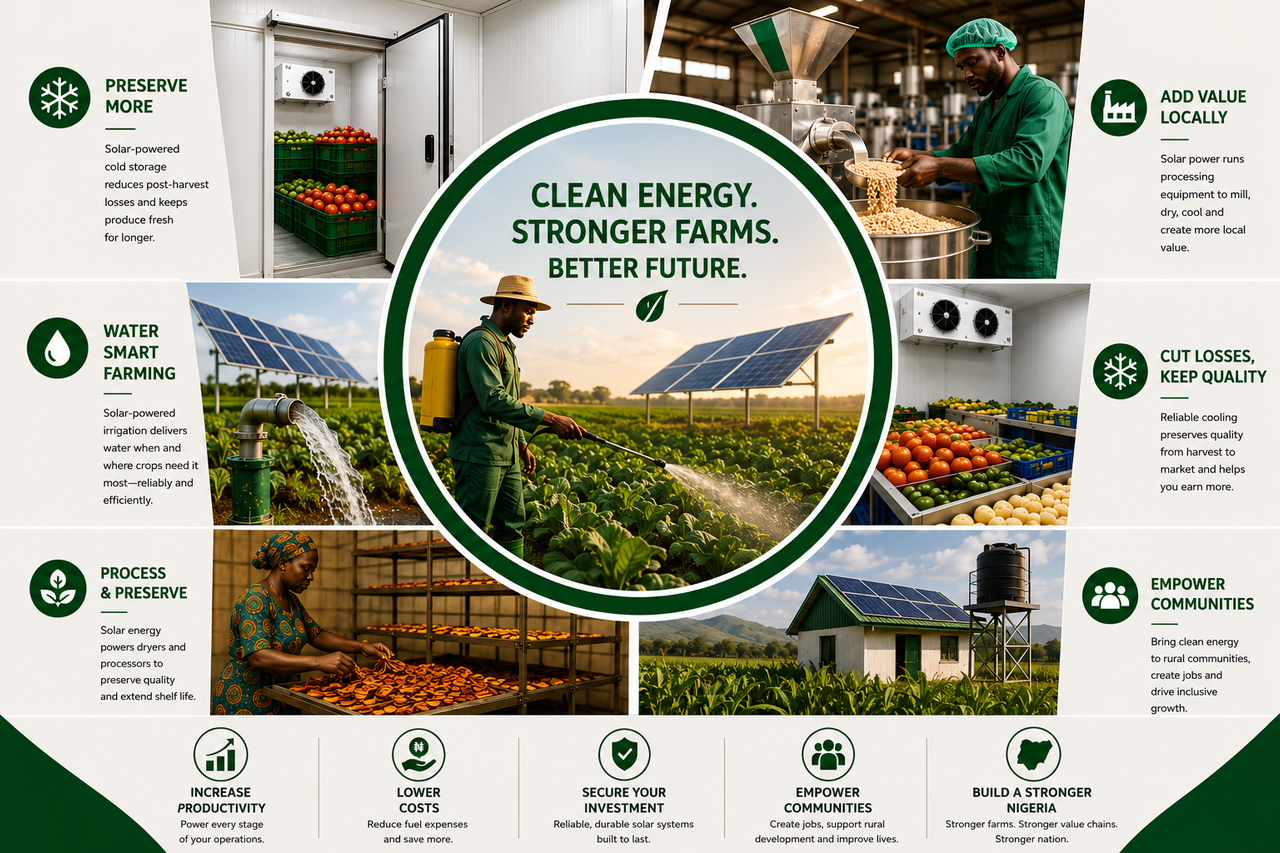
Powering More Than Homes and Businesses
Agriculture remains a cornerstone of Nigeria’s economy, supporting millions of livelihoods and supplying food and raw materials to industries. Yet, producing food is only part of the challenge. Preserving it, processing it and transporting it to consumers in good condition are equally important.
For many Nigerian farmers and agricultural businesses, unreliable electricity and the high cost of generator operation make these activities more expensive and difficult to sustain.
A farmer harvesting perishable crops may struggle to find affordable cold storage. A poultry farmer needs dependable electricity for essential equipment, while a food processor may spend a significant portion of revenue on fuel to operate machinery.
These challenges highlight an often-overlooked application of solar energy: its ability to support agricultural productivity.
With properly designed systems, solar power can help farmers irrigate their crops, preserve produce, operate processing equipment and reduce dependence on conventional electricity sources. In a country seeking to strengthen food security and improve agricultural value chains, this opportunity deserves greater attention.
1. The Hidden Cost of Unreliable Electricity
Electricity is essential at almost every stage of modern agriculture, from pumping water and operating machinery to refrigeration, packaging and storage.
When grid electricity is unavailable, many businesses turn to petrol or diesel generators. Although generators provide an alternative source of power, fuel purchases, servicing and repairs increase operating expenses.
For a small agricultural enterprise, these costs can reduce profit margins and limit the ability to expand operations. Businesses may also face production delays or spoilage when electricity interruptions affect essential equipment.
Solar energy provides an alternative by generating electricity at the point of consumption. Depending on the application, a solar installation can power equipment during daylight hours, while battery storage can support selected loads when sunlight is insufficient.
The financial benefit depends on the business's energy requirements, existing fuel expenditure, equipment efficiency and the cost of the proposed installation. Nevertheless, reducing generator runtime can help agricultural businesses control recurring energy costs and plan operations more effectively.
2. Reducing Post-Harvest Losses Through Solar-Powered Cold Storage
One of the most promising applications of solar energy in agriculture is food preservation.
Products such as tomatoes, vegetables, fruits, fish and dairy products can deteriorate rapidly when stored under unsuitable conditions. Without reliable refrigeration, farmers and traders may be forced to sell produce quickly, sometimes at reduced prices, or risk losing part of their stock.
Solar-powered cold rooms offer a potential solution, particularly in rural communities, agricultural markets and fishing areas where grid electricity is unreliable.
A properly designed system combines solar panels with suitable refrigeration equipment and, where necessary, battery storage or thermal storage to maintain the required conditions.
Reliable cold storage can give farmers and traders greater flexibility over when to sell their products, help preserve quality and support more organised distribution.
However, different products require different storage temperatures and handling procedures. The refrigeration system must therefore be designed around the specific products, storage volume and operating requirements.
By improving access to dependable cold storage, solar energy can help agricultural businesses preserve more of the value created at harvest.
3. Solar Irrigation: Supporting Farming Beyond the Rainy Season
Many Nigerian farmers depend heavily on rainfall, making agricultural production vulnerable to seasonal changes and irregular water availability.
Irrigation can help farmers maintain production during dry periods, but pumping water requires energy. For farmers relying on diesel-powered pumps, fuel costs can make irrigation expensive.
Solar-powered water pumps offer an alternative by using electricity generated from photovoltaic panels to move water from suitable sources to agricultural fields.
Depending on the farm's requirements, water can be delivered directly to crops or stored in tanks for later use. When combined with efficient irrigation methods, solar pumping can help reduce fuel expenditure and improve access to water.
However, the right system depends on the water source, pumping depth, required flow rate and farm size. Sustainable water management is equally important to prevent excessive groundwater extraction.
For farmers who can benefit from irrigation, solar pumping presents an opportunity to improve water access while reducing dependence on fuel-powered equipment.
4. Powering Agricultural Processing and Rural Businesses
Nigeria has significant opportunities to create additional value from its agricultural products.
Cassava can be processed into garri and flour, rice can be milled, and fruits can be dried or converted into other products. These activities can create employment and increase the value of agricultural produce before it reaches consumers.
However, processing equipment requires reliable electricity. Small and medium-sized processors may struggle with generator costs and interruptions that restrict production.
Solar energy can support suitable processing machinery, refrigeration, packaging equipment and other electrical loads. Businesses operating mainly during daylight hours may be able to use solar electricity directly, while facilities operating at night may require battery storage or another backup source.
In March 2026, the United Nations Development Programme reported on a 50-kilowatt-peak solar mini-grid commissioned in Namu, Plateau State. The project was designed to benefit more than 1,555 people, including 180 women rice processors, and support activities such as rice milling and cassava processing.
The project illustrates how solar electricity can support productive economic activities beyond basic household lighting.
For Nigeria, expanding such applications could help rural businesses process more produce locally, create additional income opportunities and strengthen agricultural value chains.
5. Is Solar Energy a Worthwhile Investment for Farmers?
Although solar offers considerable potential, its financial benefits depend on selecting the right system for the intended application.
A farmer considering solar irrigation should compare the installation cost with existing pumping expenses, including fuel, maintenance and operating hours.
A cold-storage operator should assess refrigeration demand, storage capacity, operating schedules and the cost of maintaining appropriate temperatures.
An agricultural processor should consider machinery ratings, production hours, starting currents and the financial consequences of electricity interruptions.
The assessment should also account for installation costs, expected solar generation, maintenance, battery replacement where applicable and any electricity still required from the grid or a generator.
For businesses with substantial daytime electricity demand, solar may be particularly attractive because generation can coincide with operating hours. Applications requiring continuous refrigeration or overnight processing may need additional storage or backup arrangements.
The objective should not simply be to purchase solar equipment. It should be to determine whether the proposed installation can meet the business's needs at a reasonable long-term cost.
Professional system design is essential to achieving that outcome.
Conclusion: A New Opportunity for Nigerian Agriculture
Nigeria's agricultural development depends not only on producing more food but also on preserving, processing and distributing it efficiently.
Unreliable electricity and expensive generator operation can make these activities more difficult, particularly for small businesses and rural enterprises.
Solar energy offers a practical opportunity to address some of these challenges through cold storage, irrigation, agro-processing and other productive applications.
It is not a substitute for good agricultural practices, adequate financing, reliable transportation or wider infrastructure investment. Nor will every solar installation deliver the same financial returns. Its success depends on appropriate system design, suitable equipment and a clear understanding of the business's energy requirements.
Nevertheless, solar power can help farmers and agricultural businesses reduce fuel dependence, improve operational flexibility and create greater value from their products.
At Maxprotech Power Solutions, we believe reliable energy should support more than everyday electricity needs. It should help businesses grow, industries become more productive and agricultural enterprises unlock their full potential.
For farmers, processors and agricultural businesses exploring solar-powered solutions, the first step is a professional assessment of their energy requirements to determine the most suitable system for their operations.
Need a system sized for you?
Call or chat with us on WhatsApp, or request a free quote.